
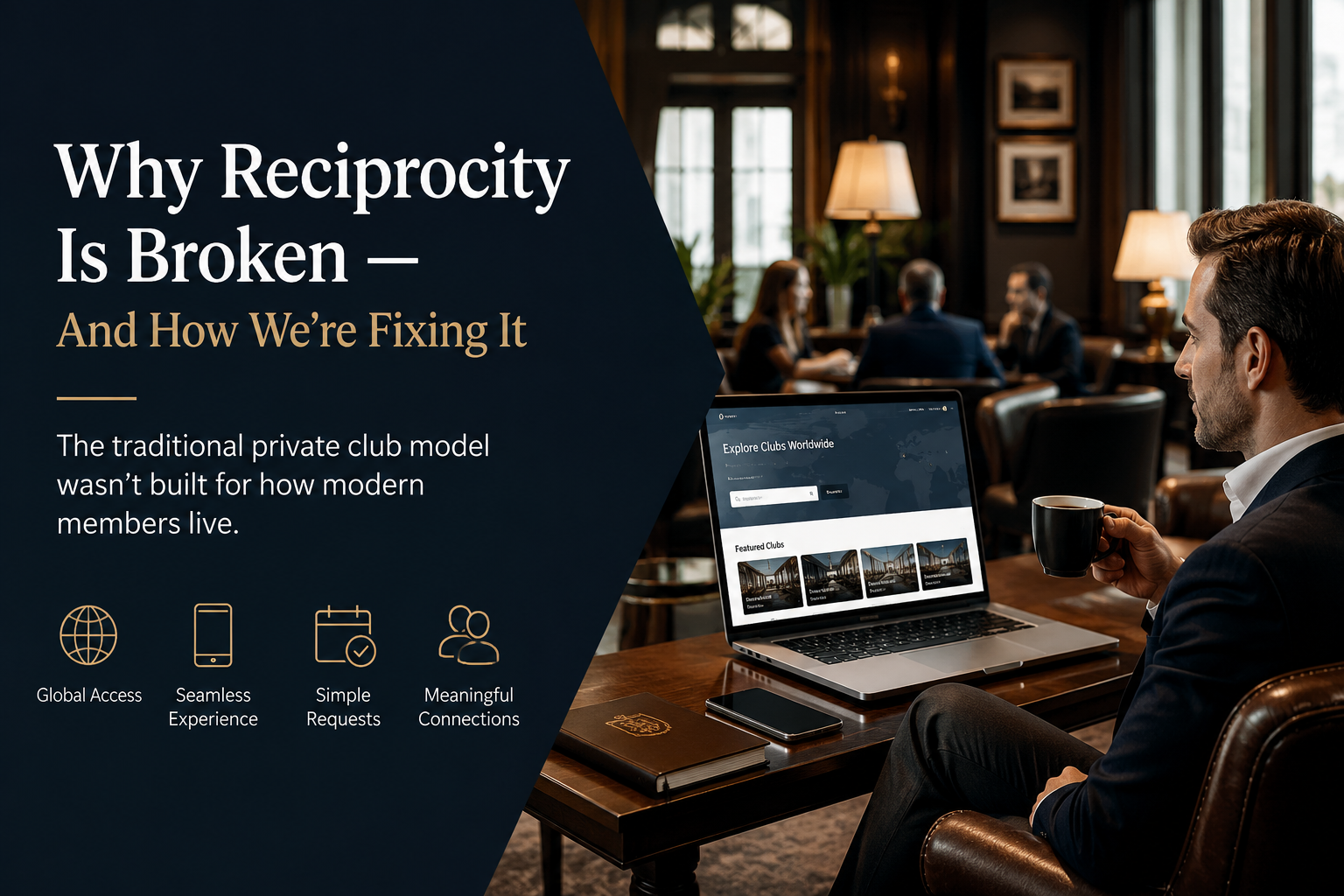
For generations, reciprocal club arrangements have been one of the defining benefits of private club membership. They promised access to a wider network of clubs, allowing members to enjoy hospitality beyond their home club while travelling for business or leisure.
In principle, it remains an attractive idea.
In practice, however, the experience often falls short of modern expectations.
The reality is that the traditional reciprocity model was created for a very different era—one in which travel was less frequent, club networks were smaller, and member expectations were simpler. Today's members live differently. They travel more often, belong to multiple professional and social communities, work remotely, and expect seamless digital experiences in almost every aspect of their lives.
Unfortunately, reciprocity has not kept pace.
Access to reciprocal clubs is often fragmented across multiple agreements, with varying rules, eligibility criteria, blackout periods, and booking processes. Many requests still depend on lengthy email exchanges between clubs, requiring manual approvals that can take days. Members frequently have limited visibility into which clubs are available, what facilities they can access, or how to make a request.
For clubs, managing reciprocal requests can be equally challenging. Staff spend valuable time coordinating enquiries, verifying memberships, handling paperwork, and responding to repetitive questions instead of focusing on delivering memorable member experiences.
The result is a system that creates unnecessary friction for everyone involved.
This is not because reciprocity is a flawed concept. Quite the opposite. The value of connecting members across trusted clubs has never been greater.
What needs to change is the way it is delivered.
At YoungClubNet, we believe reciprocity should feel effortless. Members should be able to discover participating clubs, understand access privileges, submit requests, and receive updates through a single, intuitive platform. Clubs should have simple tools to manage requests efficiently while maintaining complete control over their own access policies and approval processes.
More importantly, reciprocity should become more than just access.
Modern club members are increasingly looking for meaningful experiences wherever they travel. They want opportunities to connect with like-minded people, attend curated events, explore local recommendations, and engage with communities that reflect their interests. The club should become a gateway to the destination, not simply a place to dine or work for a few hours.
Technology makes this possible, but technology alone is not the answer.
The real opportunity lies in creating a trusted network where clubs retain their individuality while benefiting from shared standards, improved discoverability, and a smoother member journey. By reducing administrative effort and improving transparency, clubs can spend more time delivering the hospitality that makes them distinctive.
Reciprocity was always intended to extend the value of club membership beyond a single address.
Today, it has the potential to become something much more powerful: a connected global network that reflects how modern members live, work, and travel.
The future of reciprocity is not simply about visiting more clubs. It is about making every connection easier, every experience richer, and every membership more valuable—for both members and the clubs that serve them.
YoungClubNet exists to help make that future a reality by bringing clubs and members together through a connected, digital-first reciprocity network designed for the way people live today.